

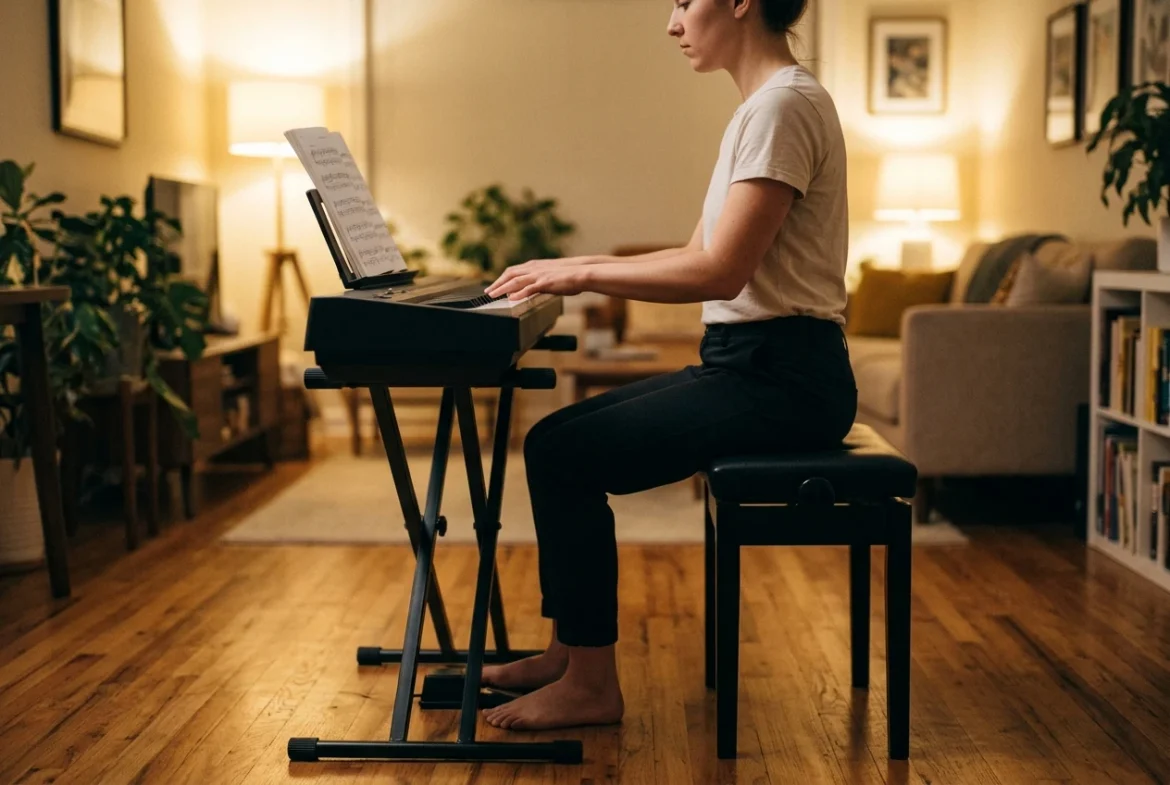
If you are weighing up a Piano Marvel Black Friday deal, or you have already bought one, the discount is the easy part. The harder part is sitting down at the keyboard on day 3, day 12 and day 25 when nothing is forcing you to. A lower price does nothing for your playing unless the subscription turns into a routine.
This plan covers the first 30 days: what to answer before you buy, how to set up on day one, and what to practise each week. It is written for complete beginners, and it works with any online piano course.
Before you buy: three questions to answer about your own practice time
A subscription is cheapest per lesson when you use it often. These three questions take five minutes and tell you whether the next month will go well.
When, exactly, will you practise? “Most evenings” is not an answer. Pick a clock time, such as 7:30 after dinner or 6:45 before work, and write it in your calendar. Twenty minutes at a fixed time beats an hour you intend to find someday.
Is your instrument ready to play? A keyboard folded away in a cupboard gets used far less than one that is set up and switched on. If you have no instrument yet, sort that out before the subscription starts, because the software is useless without something to play. Full-size keys are worth looking for, and touch-sensitive keys (where pressing harder gives a louder note) make practice feel closer to a real piano.
What will you do when you miss a day? You will miss days, especially in late November and December. Decide now that a missed day means a short session the next day, not a long catch-up and not quitting. A ten-minute session counts.
If you cannot answer the first question, wait to buy. A discount that expires in a few days is not worth more than a plan you will follow.
Day one setup: keyboard position, posture and connecting your instrument
Spend the first session on setup, not on lessons. Bad habits formed in week one are slow to undo.
Position the keyboard and bench
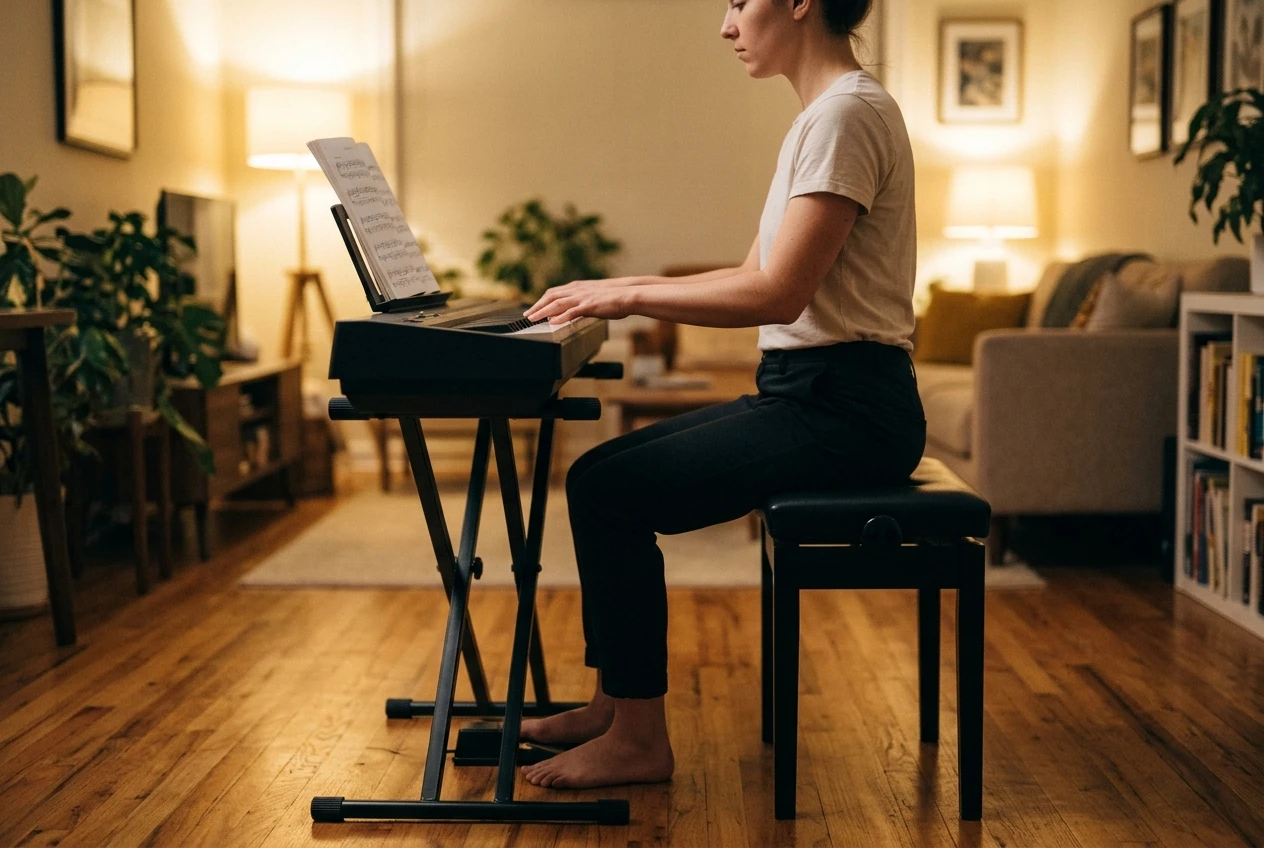
Place the keyboard at a height where your forearms are roughly level with the keys when your hands rest on them. If your elbows hang well below the keys or your shoulders rise, the height is wrong. A desk is usually too high and a coffee table too low, so a proper keyboard stand or an adjustable bench makes a real difference.
Sit on the front half of the bench, with your back upright but not stiff, and your feet flat on the floor. Center yourself on the keyboard so the middle of your body lines up with the middle of the keys.
Hand shape
Rest your hands on the keys with your wrists level, neither dropped below the keys nor arched above them. Curve your fingers as if holding a small ball. Straight, flat fingers slow you down and tire your hands.
Connect your instrument
Most digital keyboards connect to a computer or tablet by a USB cable, and the software will have its own setup or settings page that says which connection types it supports. Follow that page rather than guessing. Once connected, press a few keys and confirm the software responds to them. If it does not, check the cable, then the keyboard’s own settings, then the software’s help pages before you spend your whole first session troubleshooting.
Also check the volume. Playing too quietly to hear yourself makes it hard to notice mistakes, and headphones solve the problem if you share a home.
Finish day one by opening the first lesson and watching it through once without pressing anything. That is enough for the first day.
Week one: finding middle C and playing your first simple pieces
Everything on the keyboard is located relative to the black keys, which come in groups of two and groups of three. Middle C is the white key immediately to the left of the group of two black keys nearest the center of your keyboard. Find it, play it, and say its name out loud. Then find every other C on the keyboard, using the same two-black-key landmark.

Once C is secure, the other white keys follow from the musical alphabet: A, B, C, D, E, F, G, then back to A. Starting from C, your right-hand thumb sits on C, and your other fingers rest on D, E, F and G. This is the standard starting hand position in most beginner methods, and it is where your first pieces will begin.
For the week, aim for this:
- Days 1 and 2: Locate middle C and the other Cs. Learn finger numbers (thumb is 1, little finger is 5).
- Days 3 and 4: Play the five notes C to G with your right hand, slowly, going up and down.
- Days 5 and 6: Work through the first simple pieces in the course, one hand at a time.
- Day 7: Replay the pieces you have learned, and rest on anything that still feels shaky.
Slow is correct here. Play at a speed where you rarely make mistakes. Speed comes from repetition, and rushing builds the mistakes in.
Weeks two and three: a 20 minute daily practice routine that fits around the holidays
By week two you have the basics, so the job is consistency. Twenty minutes a day is enough for a beginner, and it is short enough to survive a crowded December. Split it into four parts:
- Warm-up (3 minutes). Play the five-finger patterns you already know, slowly, with relaxed hands.
- Review (5 minutes). Replay the previous day’s material. This is where it becomes familiar.
- New material (8 minutes). Work on the current lesson. Take small sections of two to four measures, and repeat each one until it is clean before joining them.
- Play for fun (4 minutes). Play anything you enjoy, even a piece you already know. This keeps practice from feeling like homework.
Use a timer so you are not watching the clock. If the software has a metronome or a tempo control, start slower than seems necessary and raise the speed only when you can play a section three times in a row without an error.
Fitting practice around the holidays
Weeks two and three fall in the busiest stretch of the year. A few adjustments help:

- Practise at the same time each day, even if the location changes.
- On travel or guest days, do the warm-up and review only. Ten minutes keeps the habit alive.
- Split a session into two ten-minute blocks if a single block is hard to find.
- Leave the keyboard on and the lesson open, so starting takes no setup.
Never skip two days in a row if you can help it. The second day off is where most people stop returning.
Week four: choosing a first song you actually want to play
By now you can read a few notes, keep a steady pace and play both hands for short stretches. This is the point to choose a song for its own sake, not because the next lesson says so. Motivation for the long term comes from playing something you love hearing.
Pick a song with these features:
- You already know the tune, so you can tell when a note is wrong.
- It uses mostly stepwise movement and a limited range of notes.
- The beginner arrangement is short, ideally under a page.
Since it is late in the year, a seasonal tune is a natural choice, and the article on how to learn Christmas songs on piano covers which ones suit a beginner and how to approach them before the holidays. Whatever you choose, learn it in sections, hands separately first, and then together at a slow tempo.

Set a small goal, such as playing the whole song through once without stopping, even if it is slow. That is a realistic result for week four and a good thing to play for family.
How to tell if the lessons are working for you, and what to adjust if they are not
After 30 days, check yourself against these signs that the lessons suit you:
- You have practised on most days, and you know roughly when the next session will be.
- You can find middle C and the surrounding notes without counting from the edge.
- You can play a short piece with both hands, slowly, with few errors.
- You look forward to at least part of each session.
If most of those are true, keep going and move on to the next level of lessons.
If they are not, work out which part is failing before you change anything:
- You are not practising. The issue is the schedule or setup, not the course. Move the practice time, shorten sessions to 10 minutes, or keep the keyboard out and powered on.
- You practise but feel stuck. Slow down and go back one lesson. Playing hands separately for longer usually clears it.
- You are bored. Bring the song-choice step forward. Learning something you care about earlier is fine.
- The software setup keeps getting in the way. Recheck the connection and the volume, and read the software’s help pages. If problems continue after that, the course may not suit your equipment or your way of learning.
For a closer look at what the platform offers and who it suits, the Piano Marvel review for 2026 goes through the details, which helps if you are deciding whether to renew or switch after the first month.
A Piano Marvel Black Friday deal, or any discounted plan, pays off when it is paired with a fixed practice time, a keyboard that is ready to play and a first song you want to hear yourself play. Set those up this week and the first 30 days will take care of themselves.