

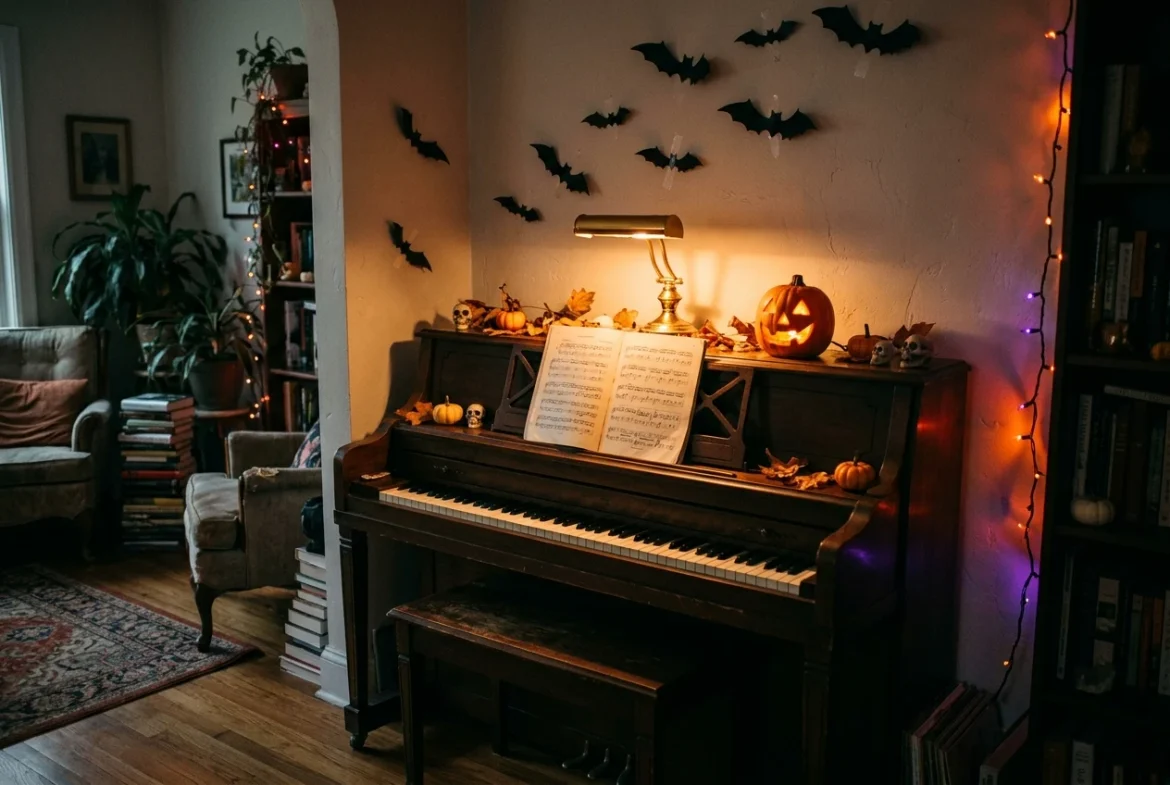
Easy Halloween songs to play on piano are mostly short, repetitive and built on a few predictable sounds. If you have an evening free, you can learn one well enough to play it for anyone who walks through the door. The list below runs from easiest to hardest, so you can find your level and start. First, a few minutes on why this music sounds spooky, because that knowledge lets you adapt almost any melody.
Two of the best ways to learn piano online in a fun and captivating way are via Piano Marvel and Playground sessions. Check them out!
Why minor keys and tritones sound spooky (and how to use them)
Most cheerful tunes use a major third, the interval between C and E. A minor third lowers that note by one semitone, so C moves to E-flat, and the sound turns darker and more uneasy. Playing a familiar melody with its third lowered is the quickest way to make it sound haunted.
The tritone is the second tool. It spans six semitones, for example C up to F-sharp (or G-flat, the same key on the piano). It sounds unresolved and tense, as if the music is waiting for something to happen. Composers have long used it for menace, and it has an old nickname, “diabolus in musica,” meaning the devil in music.

You do not need to read theory to use either one. Find the two notes on the keyboard, press them together or one after the other, and listen. Both are used in the pieces below, and you will hear them once you know what to listen for.
Beginner picks: Halloween tunes you can play in an evening
These are ordered from easiest to a little harder. Check the stated level on the page before you buy or download any arrangement, since the same piece is published at very different difficulties.
- Two-note menace. This is a technique more than a song. Alternate two neighbouring notes, such as E and F, starting slowly and gradually speeding up. John Williams used this idea for the shark in Jaws, and it works for any approaching monster. You can play it in under a minute.
- The Addams Family theme. The melody is short and catchy, and the finger snaps in the original are part of the fun. Beginner versions usually keep the tune in the right hand and put simple notes in the left. Get the rhythm of the snaps right and people will recognise it immediately.
- Halloween theme (John Carpenter). The famous piano riff is in 5/4 time, which means five beats to a bar. The notes are not hard, but the rhythm is unusual. Count it as 1-2-3, 1-2 and keep repeating the pattern. Once the count feels natural, the piece is mostly repetition.
- In the Hall of the Mountain King (Grieg). The melody creeps along in single notes, then repeats a little louder and faster each time. Play it hands separately at a slow tempo first. At that speed it is manageable for a beginner, and the gradual speed-up gives it its drama.
- This Is Halloween (Danny Elfman, from The Nightmare Before Christmas). Simplified versions exist that keep the main tune and reduce the busy accompaniment. It is the longest piece on this list, so learn it one section at a time.
Intermediate picks: classics that sound as scary as they look
If you have played for a year or more, or you are returning after a long break, these pieces reward more work.
- Funeral March of a Marionette (Gounod). Many people know it as the theme of Alfred Hitchcock Presents. The tune is easy to recognise, and the challenge is keeping a steady, mocking march in the left hand while the right hand plays crisp, detached notes.
- Toccata and Fugue in D minor (attributed to Bach). It was written for organ, but piano transcriptions exist. The opening is the famous part: a quick flick on A followed by a descending line down to D. Learning just those first bars, played in octaves with the pedal, gives you a dramatic opening that sounds far harder than it is. Playing the whole piece is a much bigger project.
- Funeral March (Chopin). This is the slow movement of his Piano Sonata No. 2, in B-flat minor. The heavy, tolling left-hand chords carry most of the effect. The opening is a good choice if you like slow, serious music over fast, flashy playing.
- Danse Macabre (Saint-Saëns). It is built around a tritone and a spooky dance rhythm, and piano arrangements are available at several levels. Choose the arrangement carefully, because some are far more demanding than others.
The three-note trick that makes any melody creepy
Press C, E-flat and G-flat together. This is a diminished triad: each note sits a minor third above the one below, and the outer notes (C and G-flat) form a tritone. It is a minor sound and a tritone in one chord, and it sounds tense on its own.

To use it, play the chord low in the left hand and let it ring with the sustain pedal. Then play a simple melody above it, such as “Twinkle, Twinkle, Little Star” or “Row, Row, Row Your Boat”, in the right hand. Lower the third notes of the melody if you like. Even the simplest tune turns eerie over those three notes.
You can vary the effect in two ways:
- Tremolo. Rock quickly between two of the chord notes in the low register, such as C and E-flat. Keep it quiet and even, and it sounds like a rumble under the floor.
- Roll the chord slowly. Play C, then E-flat, then G-flat, one after another, with the pedal down. It sounds like something creeping up the stairs.
How to practise a short piece quickly without sloppy playing
Quick learning works when the practice is organised. This method suits a one-evening project.
- Listen first. Play a recording once or twice so you know where the piece is going.
- Divide it into phrases. Mark every two or four bars. Learn one phrase at a time and do not move on until it is clean.
- Work hands separately. Do this even if the piece looks easy. Many mistakes come from the left hand being unfamiliar.
- Slow down. Use a metronome or a timer app, and set it to a speed where you can play without errors. Raise the speed only when three runs in a row are clean.
- Loop the hardest bar. Repeat the one or two difficult bars on their own, then connect them to the bar before and the bar after.
- Stop when it gets sloppy. If mistakes start multiplying, rest for a few minutes. Practising errors teaches your hands the errors.
Do a short run-through of the whole piece at the end of the evening. Even if it is slow, playing from start to finish builds the habit of continuing past mistakes, which you need when people are listening.
If you want lessons that go beyond a single seasonal piece, online platforms such as Piano Marvel and Playground Sessions let you learn piano at home and work through material at your own pace.
Playing for trick-or-treaters, parties and family: setting up your piano for Halloween night
A little preparation helps you play well when the doorbell keeps ringing.
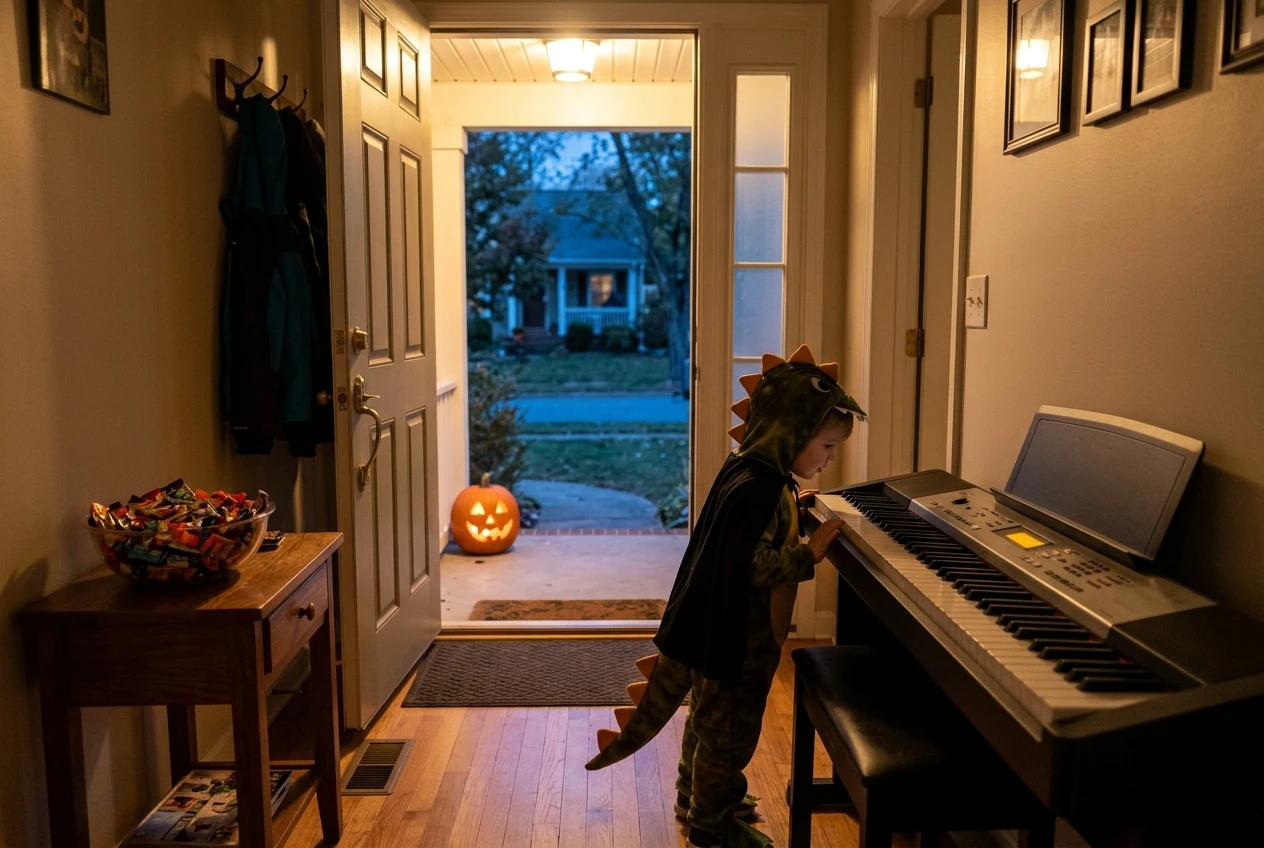
- Pick a loopable piece. Short, repetitive pieces such as the Halloween theme or a two-note menace figure can be started and stopped at any point. You do not have to finish a long piece before answering the door.
- Prepare a short set. Two or three pieces of different moods, say one playful and one spooky, give you variety without much to remember.
- Use your instrument’s sounds. If your digital piano or keyboard has organ, harpsichord or choir settings, try them. An organ sound suits the Toccata, and a harpsichord sound suits the Addams Family theme.
- Check the volume and position. Make sure the piano is audible from the door but not so loud that it drowns out conversation. Keep the music, the bench and a light where you can reach them in the dark.
- Invite others in. Children often enjoy pressing the low keys or trying the two-note menace on their own. Show them the notes and let them join in.
- Keep the sheet music in order. Clip or tape the pages so a draught from the open door does not scatter them.
Where to find sheet music and what to look for in an arrangement
Pieces in the public domain, such as the Bach, Gounod, Grieg, Chopin and Saint-Saëns works above, can be found free on IMSLP, the online library of public domain scores. Many editions there are for advanced players, so look for simplified or excerpted versions, or search for beginner arrangements from other publishers.
Film and television themes, such as the Addams Family, Halloween and The Nightmare Before Christmas, are still under copyright. Download or buy licensed arrangements from sheet music retailers such as Musicnotes or Sheet Music Plus, or look in Halloween collections in music shops. Community sites such as MuseScore also host user-made arrangements, and their quality varies, so listen to the playback before you start.
When you compare arrangements, check these points:
- Stated level. Look for labels such as beginner, easy or intermediate, and read the preview page when one is available.
- Key signature. Fewer sharps and flats usually mean an easier read. A piece with a heavy key signature is a good choice only if you are comfortable with it.
- Hand position. Beginner versions should keep your hands in one position for long stretches, without large jumps.
- Fingering and markings. Fingering numbers, pedal marks and dynamics save you time on a short project.
- Completeness. Make sure the arrangement includes the part everyone recognises, not only the introduction or a distant variation.
Choose one piece from the beginner list tonight, learn the first phrase, and add the diminished chord underneath once the notes are steady. When you are ready to keep going after Halloween, don’t forget to check out Piano Marvel and Playground Sessions!